Sunday, January 30, 2011

Book to Movie: The Princess Diaries


The Princess Diaries
by Meg Cabot

Book published in 2000, movie released in 2001

Mia Thermopolis is your average girl living in New York.  She is 15, a freshman at Albert Einstein High School (a private school), flat-chested, failing algebra, a bit shy, and without a boyfriend.  Luckily, she and her best friend, Lilly, are a great pair, considering they have been friends since kindergarten.  Mia lives in a renovated warehouse with her eclectic artist mom, Helen, and cat Fat Louis.  Her parents were divorced before her birth, although she sees her dad pretty regularly.  Her life is going pretty smoothly until one day, her father comes to town and needs to meet with Mia about something important.  Her life changes forever when she finds out that he is a prince, and she is a princess!  Throughout this part of the saga, she is not at all excited about being royal--she just wants to be normal.  Before she knows it, her grandmother (Grandmere) comes to town to give her "princess lessons," she is being driven to school every day by her father's driver, and she has a full-time bodyguard.  She does not tell her friend Lilly about the "princess-ness" until it comes out through the media, so she is without the support of nearly anyone her age until the very end of the story.  After her school becomes the target of mass-media on a daily basis, the most popular boy in school asks her to the school dance, but only as a publicity stunt.  Devastated, Mia finally sees what being a true friend entails when she and Lilly resolve their friendship, as well as Mia potentially having a REAL boyfriend in the next novel (Lilly's brother, Michael). 

When I originally read this book years ago, around the time of the movie, it seemed like it was much more similar to the movie than I now realize that it is.  In the book, Mia's parents are simply divorced, and Mia is only told that she is a princess due to his lack of being able to produce another heir; in the movie, the father dies, and since there is no other heir to the throne, Mia is told by the grandmother of her royal status.  In addition, the book is set in New York; the movie is solidly set in San Francisco--providing a much different background and culture.  Mia is friends with both Lilly and Michael in the movie, but there is no mention of Tina Hakim Baba (who in the book Mia spends a great deal of time being friends with while split with Lilly).  The grandmother's character is also a bit different--in the book, she seems very unfriendly, smokes and is generally not likeable to be around; in the movie, Julie Andrews plays the strict-then-compassionate grandmother role, minus the cigarettes, hotel suite, calling of the media, and general lack of compassion for Mia that she exhibits in the movie.  Personally, I like the movie's story better.  I feel more comparable to Mia in the movie, possibly because her character is much like me in high school.  In the movie, Mia is a bit more intelligent than in the book--she is not failing Algebra, but instead P.E.  Mia's mother is dating one of her teachers, but it is not such a big deal as she makes it in the book.  I also think that watching the transformation from commoner to princess in the movie is much more interesting, as well as entertaining.  The main aspect of reading the book that I like BETTER than watching the movie is that the story continues through another 15 books by the same author, rather than just one more movie.

Saturday, January 29, 2011

Book to Movie: Holes

Holes
by Louis Sachar

Book published in 1998, movie released in 2003
Newbery Medal book

Stanley Yelnats IV, an average kid, has the same luck as all the men in his family--being in the wrong place at the wrong time.  While walking down the street, a pair of baseball cleats fall from the sky on his head, and before he knows it, he is arrested for theft and sentenced to 18 months at Camp Green Lake, a camp for juvenile-delinquents.  Upon arrival at the camp, he is sent to Group D, joining X-Ray, Armpit, Zig-Zag, Twitch, and Zero (other campers’ nicknames), where they are told to show him the ropes of camp life.  Each day, campers are to dig a 5x5 foot hole, meant to “help them develop character.”  However, the holes are also for the campers to search for “interesting items,” which can help them get the day off.  The Warden is a woman in search of artifacts of Kissin’ Kate Barlow, a fugitive of the old days when Green Lake actually included a beautiful lake, as well as an entire town.  Stanley, given the nickname of Caveman, makes friends with Zero, agreeing to teach him to read in exchange for help digging his holes because he is very slow at digging.  Zero eventually runs away, although supposedly no one makes it alive because if campers try to run away, there is no water for 100 miles.  Stanley goes after Zero, helping to reverse his family curse, as well as finding the treasure hidden below the ground that the Warden has been searching for so long.  Stanley is acquitted of the charges, and Zero is allowed to leave because the Warden deleted his records—so he has no past and no criminal record!

This is one book that the movie follows to a "T."  I am not aware of any book that I have ever read that the movie was so well aligned.  This is a great book and great movie (especially due to the then-cutie Shia LaBeouf!)  For me, being able to watch a movie that is based on a book is a real treat; I can then put a face to the names of the characters that I read about in the book, as well as seeing the setting in real-life.  I am a reader that needs to be able to "see" what I am reading, so seeing movies that follow books so well is a definite plus for me.  I am also a big fan of the author, Louis Sachar, who also wrote the Wayside School stories that I LOVED as a child.  Sachar has a way of putting humor into his works so that it seems the story is being told by the character instead of the middle-aged author--definitely a great idea when trying to addict the reader!

Wednesday, January 26, 2011

Coretta Scott King Award: Bud, Not Buddy

Bud, Not Buddy
by Christopher Paul Curtis

2000 Coretta Scott King Author Award Winner

In this story, the reader is transported back to 1936, in the middle of the Great Depression.  Bud is our main character, who is a negro boy whose mom passed away four years ago.  Although he may be only 10 years old, he has already experienced a lifetime of hardship, grief, homelessness, hunger and sufferings--but those factors do not keep him down.  He is able to escape the mean Amoses, a foster family he is given to in the beginning of the story, but not before their son Toddy beats him to a bloody pulp and Bud lands himself a night locked in their shed, as well as face-full of hornet stings and fish-teeth scratches.  He escapes, but rather than going back to the orphanage, he camps outside the library and later in a "Hooverville," a 'cardboard jungle' in his hometown where many other homeless Negros live.  He intends to make it out west to help pick fruit and earn a living with his friend Bugs, but ends up missing jumping on the train.  Instead, all alone, he decides to walk to Grand Rapids in search of his father, the famous Herman E. Calloway who has been in countless bands travelling throughout the country.  Although his mother had never officially told him who his father was, Bud is a smart-enough kid to put together the clues he saw throughout his childhood--like the rocks with city names and dates, all the band flyers his mom had held onto (which had also made her cry), and other mementos.  He ends up hitch-hiking with Lefty Lewis, who he lies to and says that he is actually FROM Grand Rapids and ran away from, all in hopes that the man will take him back home.  He does, and Bud finally makes it to Grand Rapids.  He meets Mr. Calloway, who doubts his story but lets him stay regardless.  In the end of the story, all the details of Bud's mom's life come rushing out, confirming not that Herman is Bud's father, but instead Bud's mom's father--Bud's grandfather.

I was not greatly interested in reading this story at first; however, after getting used to Bud's dialogue and thought-process, could not put the book down.  To me, it seemed too easy for Bud to make it to Grand Rapids, find his father, and live happily-ever-after.  When the story turned and I began to realize that Herman was not Bud's father but instead his grandfather, this seemed the perfect fit.  Honestly, I had been wondering all along what Bud's mother had been thinking if she had been seeing/dating Herman enough to become pregnant, because he seemed to me like a real jerk.  However, I can definitely see him instead as a father that pushed his daughter so hard that he pushed her away--he appears to be much more of that persuasion.  I can think of people that I went to college with that had parents like that--who wanted so much out of them that the child eventually cracked under the pressure and either went insane or completely rebelled.  In this story's case, Bud's mom rebelled, moved across the state, got pregnant with a child who had no father figure, and died at a very young age before ever really living her life.  When thinking about the ending of the story, I begin to to wonder what will happen to Bud now--now that his ancestry is known, after he has been taken in by Mr. Calloway's band, and he has a full stomach and a good night's sleep.  Will they keep him around and let him join the band?  Will Bud get frustrated with his grandpa and run away like his mother did? In the times of the Great Depression, I would not put anything past Bud!  Bud, Not Buddy is definitely a story deserving of not only the Coretta Scott King award, but also of the Newbery award that it was given.  The story is a timeless one that can be read by any age level--read to one's self if old enough, or read-to if a younger child.  It teaches the reader to not only appreciate all that we have, but also the wisdom that Bud held on to--that when one door closes, another one opens, and you just have to keep your eyes open for it.

Newbery vs. Caldecott: Which is supreme?


Newbery Medal

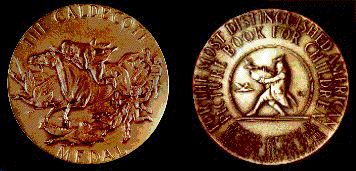
Caldecott Medal


The Great Debate:
Which is More Worthy,
Newbery vs. Caldecott?


Background on Newbery Medal:

The Newbery Medal, named for 18th century bookseller John Newbery, is given each year to the most distinguished American children's book published the previous year by the American Library Association.  According to the ALA website, the purpose of the award is
"to encourage the original creative work in the field of books for children; to emphasize to the public that contributions to the literature for children deserve similar recognition to poetry, plays or novels; to give those librarians, who make it their life work to serve children's reading interests, an opportunity to encourage good writing in this field."
The book must be written in English (not translated), an original work, not previously published, and overall "distinguished."


Background on the Caldecott Medal:


The Caldecott Medal, named for 19th century illustrator Randolph J. Caldecott, is given each year (since 1937) to the artist who created the most distinguished picture book of the year.  Originally, only the Newbery award was given to the most distinguished children's book of the year; however, as people started noticing that the illustrators of books were not being given any recognition for their work, Frederic G. Melcher realized that a second award needed to be given to honor and encourage great illustrators--leading to the birth of the Caldecott Medal.  According to the ALA website, the honor is
"awarded to the artist of the most distinguished American Picture Book for Children published in the United States during the preceding year. The award shall go to the artist, who must be a citizen or resident of the United States, whether or not he be the author of the text. "
An interesting note: if a book is nominated for BOTH the Newbery and Caldecott, the committee decides which category it will be voted upon, so that the same title is not  considered on both ballots.


My Opinion: Which is better?
Personally, I have read some winners of both categories that are simply amazing books; on the other hand, I have read some winning books of both awards that I didn't think were that "distinguished."  If I were a writer or illustrator, I think that the higher honor would be to receive the Newbery.  For starters, I believe that more people have heard of the Newbery award than the Caldecott, so having earned it would feel a bit more superior.  In addition, children's novels take a bit more time and effort to write, especially considering that the winners in this category usually have some historical background and/or basis, meaning that they cannot be solely from the imagination of the writer.  However, looking at it from the other side, being given the Caldecott award would be pretty amazing--knowing that your illustrations, your pictures, your artwork really IS good--distinguished, to be correct.  I realize that I have no idea how much time that illustrators put into their work--perhaps just as much as the writers of Newbery winners.  Therefore, if I were in the business of writing/illustrating, EITHER award would be absolutely fantastic to be given, as well as to know that the committe chose MY work out of everything else published in that year.


Background info:
http://www.ala.org/ala/mgrps/divs/alsc/awardsgrants/bookmedia/newberymedal/aboutnewbery/aboutnewbery.cfm
http://www.ala.org/ala/mgrps/divs/alsc/awardsgrants/bookmedia/caldecottmedal/aboutcaldecott/aboutcaldecott.cfm

Newbery Honor: Princess Academy

Princess Academy
by Shannon Hale

2006 Newbery Honor Book

This book took a while for me to get into, but I knew that since it was supposed to be about a princess, I would eventually get into it.  The story focuses on the life of Miri, a mountain girl growing up on Mount Eskel, a territory of Danland.  The way that the author described the people that Miri lived with reminded me much of how some people see those from Eastern Kentucky--uneducated, hard-working, poor, and basically ignorant due to lack of formal education.  The people of this area all help to mine linder, a white stone resembling marble and known throughout the kingdom for its beauty and strength.  Miri, however, is too small to help unlike her older sister Marda, so she feels like she doesn't belong.  One day, a messenger from the king is sent to the village to announce that the prince is to be married to someone from the area, and that all girls age 12-17 will attend a Princess Academy to learn to read, write, and conduct themselves like a princess.  This proclamation is met with much disagreement from the parents of the girls, since they normally help in the mines.  However, all the girls in the age range are forced to attend the academy taught by Tutor Olana: a very strict, intelligent woman who formerly tutored children of the court.  To teach the girls, she uses various punishments like beatings of hands for speaking out, time-outs in the closet (where a rat lives), taking away of meals, and eventually she even takes away the privilege of going home for the rest day (Sunday).  Miri tries to stand up for the girls on multiple occasions, but only ends up getting herself, as well as the other girls, in trouble.  At the end of the year, the prince will come to the academy for a grand ball, where he will choose his bride--a competition that every girl wants to win.  Miri struggles throughout the book with herself, trying to be the best in the class, yet unsure if she even WANTS to be the prince's bride.  She befriends a few classmates along the way, especially Britta and Esa, which help her keep some sanity, and eventually saves the day on more than one occasion.  In the end, while still trying to figure out who/what she wants to become, she plays an integral part in saving all the girls--and ends up finding out how she truly wants to spend her life.

I really liked how this book focused on a small village and the people living there, with a relatively small set of characters.  This would make it much easier for a student to read and keep up with, especially since the character names are somewhat odd--Marda, Esa, Britta, Bena, Peder, Liana, etc.  However, I really liked how much students today could potentially identify with Miri--how she was a bit of an outcast, yet through personality and by trying so hard academically, she turned into the girl that everyone wanted to be--the girl that everyone thought the prince would choose.  She also learned a lot about herself, going from being a "child" in the beginning to a young woman at the end of the story.  Not many of the other characters grew as much as Miri did, who I think is a great example for readers to identify with.  Although I have not read any other books by the author, I would imagine that they read along the same difficulty level (which, at 314 pages might be a bit much for some readers), but the pages flew by as the story climaxed.  The author definitely has a way with words, enabling her to transport you to the mountains where Miri and her family lived without confusing the reader.

I would definitely recommend this book to be read by someone wanting to be transported to another place and time, and someone who might "beat to their own drummer"--since Miri is for sure a one-of-a-kind girl.

Newbery Award: The Higher Power of Lucky

The Higher Power of Lucky
by  Susan Patron, illustrated by Matt Phelan

2007 Newbery Medal Winner

This was a very interesting book about a little orphan girl named Lucky.  Her mom was killed by a downed power line, and her father “didn’t like children,” so her somewhat stepmother became her “Guardian” as Lucky referred to her.  Throughout the story, Lucky is worried about Brigette, her “Guardian,” not liking her and wanting to go back to her home in France.  Her main friends, Lincoln (a little boy obsessed with tying knots over and over) and Miles (a kindergartner that loves the book “Are You My Mother?” and to make strange sounds) keep her mind on other things, like school and her job cleaning up the Found Object Wind Chime Museum and Visitor Center, otherwise known for hosting “anonymous” meetings.  However, one day, Lucky thinks that Brigette is going to leave her behind and go back to France when she finds a suitcase of legal papers and her passport.  Lucky decides to run away in search of her “higher power,” and does so after seeing “signs” that mean she should.  During a massive dust storm, she decides to run away.  She comes across many obstacles along the way, including finding Miles on the road after he stepped on something sharp and got lost.  The two take shelter in an abandoned mine, along with Lucky’s dog HMS Beagle, and are eventually found by Lincoln and, shortly thereafter, the rest of the town.  In the end, Brigette explains to Lucky that she was going to legally adopt her and open a cafĂ©, and was not going to leave Lucky behind.

At first, I was horrified when I began to read about Lucky running away.  To me, Lucky seems like many 4th or 5th grade students I have met, and my thought process was basically along the lines of this: "If students see that this book won awards and the main character RAN AWAY, how likely are they to jump to conclusions when life gets hard and to do the same?"  I work in a school that is very transient, and I would not put it past some of these kids to run away when things are not easy.  However, the story worked out nicely, and hopefully if students read this story they will realize that they, like Lucky, might misunderstand adults and their intentions sometimes, and that running away is NEVER the right answer.


Although the story did scare me a bit, I did like the language that it was told in--very reader-friendly for upper elementary students.  It was a short read as well, which is always good when trying to keep the attention span of this age group. 

Caldecott Honor: What Do You Do With a Tail Like This?

What Do You Do With a Tail Like This?
by Steve Jenkins & Robin Page


2004 Caldecott Honor Book

This is a perfect book to be read by children who are interested in animals and their bodily adaptations, as well as a colorful and neatly-illustrated book to keep the interest of young children.  Personally, I could not turn the pages and read quickly enough, because I wanted to know what the use was for all the tails, eyes, ears, mouths, noses and feet, as well as what animal they belonged to.  This story is definitely not fiction as most of the children's books that I read are, but instead greatly informative and suspenseful.  (I never would have thought of a informative picture-book as being suspenseful until I read this one!) 

In a classroom setting, I would love to use this book to help children work on critical-thinking skills.  When looking at the page reading, "What would you do with ears like these?" it would provide many opportunities for children to try and guess the animal, as well as guessing the use of the body part.  Although I use the word "guess," it would be a better time to help children look at what they see in a critical way, and think their ideas through before making a hypothesis; however, it is nonetheless a great opportunity to get kids thinking about what they see!  I have read "guessing books" before to children, but never one illustrated so well and with as "kid-friendly" text as this one; I especially love the information on the skunk's tail, which is used to "warn that a stinky spray is on the way," and a chameleon's eyes are used to "look two ways at once."